IFI News
How to Follow the Path of Forgiveness
Greater Good, The Science of a Meaningful Life – Anyone who has suffered a grievous hurt knows that when our inner world is badly disrupted, it’s difficult to concentrate on anything other than our turmoil or pain. When we hold on to hurt, we are emotionally and cognitively hobbled, and our relationships suffer.
Forgiveness is strong medicine for this. When life hits us hard, there is nothing as effective as forgiveness for healing deep wounds. I would not have spent the last 30 years of my life studying forgiveness if I were not convinced of this.
That’s how Dr. Robert Enright, a a licensed psychologist and a professor of educational psychology at the University of Wisconsin-Madison, begins his own review of his recently-published book 8 Keys to Forgiveness on the website of the Greater Good Science Center at the University of California, Berkeley.
Dr. Enright is one of the world’s leading experts on forgiveness, founder of the International Forgiveness Institute, and the man Time magazine calls “the forgiveness trailblazer.” In the Greater Good article, he provides an outline of the basic steps involved in following a path of forgiveness:
1. Know what forgiveness is
and why it matters
2. Become “forgivingly fit”
3. Address your inner pain
4. Develop a forgiving mind through empathy
5. Find meaning in your suffering
6. When forgiveness is hard, call upon other strengths
7. Forgive yourself
8. Develop a forgiving heart
If you shed bitterness and put love in its place, and then repeat this with many, many other people, you become freed to love more widely and deeply. This kind of transformation can create a legacy of love that will live on long after you’re gone.
Read the complete article: “When another person hurts us, it can upend our lives.”
Read the article in Huffington Healthy Living.
Read more about the book: 8 Keys to Forgiveness.
Forgiveness: Why is it so hard?
AEON Magazine, London, Melbourne, New York – “Science is discovering what religion has always known: forgiveness is good for us. But that doesn’t make it any easier.”
That’s the opening of an article for AEON Magazine titled “Letting Go” by California writer Amy Westervelt, who writes on health issues primarily for The Wall Street Journal and The Guardian. In this article, she documents the science proving that forgiveness is healthy, but struggles to figure out why is it so hard.
After studying and interviewing forgiveness experts like Dr. Robert Enright, Professor Frederic Luskin, and Oprah Winfrey’s favorite life coach, Iyanla Vanzant, here is some of what Westervelt concluded about why forgiveness is so hard:
Forgiveness is a relatively new academic research area, studied in earnest only since Dr. Enright began publishing on the subject in the 1980s. The first batch of studies were medical in focus. Forgiveness was widely correlated with a range of physical benefits, including better sleep, lower blood pressure, lower risk of heart disease, even increased life expectancy; really, every benefit you’d expect from reduced stress.
The late Kathleen Lawler, while working as a researcher in the psychology department at the University of Tennessee in Knoxville, studied the effects of both hostility and forgiveness on the body’s systems fairly extensively. ‘Forgiveness is aptly described as “a change of heart”,’ she wrote, in summarising a series of studies focused on the impact of forgiveness on heart health. Meanwhile, Duke University researchers found a strong correlation between improved immune system function and forgiveness in HIV-positive patients, and between forgiveness and improved mortality rates across the general population. . . .
Dr. Enright has established himself as ‘the father of forgiveness’, creating a therapeutic protocol for how to practise it that was officially sanctioned by the American Psychology Association and the United Nations. He thought the Catholic Church could be doing more to emphasise its deep history in the subject, and spreading the gospel of forgiveness to the masses, and said so in a speech at the Vatican. . . .
While researchers have spent the past 20 years proving the physical and mental benefits of forgiveness, it’s the step-by-step forgiveness guides they’ve developed that might turn out to be academia’s most important contribution to the subject.
Like Vanzant’s pop-psych version, the protocols that Enright and Luskin have developed offer specific steps towards forgiveness rooted in decades of research and clinical experience. While the various approaches differ, all include practical guidance and the basics are consistent: feel the feelings you need to feel, express them, then leave them in the past where they can no longer have power over you.
What all of the researchers and pop-psych proponents of forgiveness agree on is that it takes practice and that it is hard work. Vanzant compares it to pulling out a tooth without Novocaine. Luskin described it as re-training the brain. ‘You can get upset about anything – you can also get un-upset about anything, it’s just a matter of learning how,’ he said.
Forgiveness works, and that’s what makes it so damn hard. Time does not heal all wounds. This too shall not pass. Letting go of hurt and anger is a grind, and forgiveness only works if you practise it regularly, and are prepared to fail often without giving up. But the pay-off is so huge it just might be worth it.
Read the full article “Letting Go” and watch a related video–a classic Iranian documentary that draws a forceful, poetic appeal for dignity from the harrowing images of leprosy.
Forgiveness Research Tool Being Translated into Urdu Language
The Enright Forgiveness Inventory (EFI) and the Enright Forgiveness Inventory for Children (EFI-C), both developed by researcher and psychologist Robert Enright, have become the measurement tools of choice in forgiveness research and have been used around the world. Now, thanks to a Masters Degree student in Pakistan, the children’s version of the EFI is being translated into the Urdu language.
Affaf Rahman, who is pursuing his Masters in Clinical Psychology, is translating the Enright Forgiveness Inventory for Children (EFI-C) as part of his research work on sexually-abused children. Rahman is working under the supervision of Ms. Rabia Iftikhar, Lecturer, Government College University Lahore in Lahore, Pakistan. Lahore is on the country’s eastern border with India.
“This is an exciting development that will make the EFI-C available to
Urdu-speaking researchers in South Asia as well as many other countries around the world,” according to Dr. Enright. “The International Forgiveness Institute will retain the copyright and distribution rights to this new version that will significantly expand usability of the tool.”
Consistent with the definition of interpersonal forgiveness, the EFI is an objective measure of the degree to which one person forgives another who has hurt him or her deeply and unfairly. The EFI-C is a 30-item scale similar to the 60-item adult version. The Children’s Inventory assesses a child’s degree of forgiveness toward one person for one hurtful event. It is presented orally to the child.
Urdu (or Modern Standard Urdu) is a variety of the Hindustani language. It is the national language and one of the two official languages of Pakistan, along with English, and is spoken and understood throughout the country. Urdu is also an official language of six states of India.
Urdu is historically associated with the Muslims of the region of Hindustan. Apart from specialized vocabulary, Urdu is mutually intelligible with Standard Hindi, which is associated with the Hindu community in South Asia. It evolved during medieval times (6th to 13th century).
There are between 60 and 70 million native speakers of Urdu: 52 million in India (according to the 2001 census); approximately 10 million in Pakistan; and several hundred thousand in the United Kingdom, Saudi Arabia, United States, and Bangladesh (where it is called “Bihari”). However, a knowledge of Urdu allows one to speak with far more people than that, because Hindustani, of which Urdu is one variety, is the fourth most commonly spoken language in the world, after Mandarin, English, and Spanish.
Here is a sample text in Urdu – the beginning of Article 1 of the Universal Declaration of Human Rights (by the United Nations):
Urdu text
دفعہ ۱: تمام انسان آزاد اور حقوق و عزت کے اعتبار سے برابر پیدا ہوئے ہیں۔ انہیں ضمیر اور عقل ودیعت ہوئی ہے۔ اس لئے انہیں ایک دوسرے کے ساتھ بھائی چارے کا س
English Translation (grammatical)
Article 1: All human beings are born free and equal in dignity and rights. They are endowed with reason and conscience. Therefore, they should act towards one another in a spirit of brotherhood.
Urdu is written right-to left in an extension of the Persian alphabet, which is itself an extension of the Arabic alphabet. Urdu has been one of the premier languages of poetry in South Asia for two centuries, and has developed a rich tradition in a variety of poetic genres.
Forgiveness Therapy Can Work Better Than a Pill!
“Forgiveness therapy should be part of palliative care and it can work more powerfully than a pill,” Dr. Robert Enright told attendees at the Fifth Annual Healthy Aging Conference held in Madison on Sept. 9.
Dr. Enright, who pioneered the social scientific study of forgiveness beginning more than 30 years ago, has found that forgiveness increases happiness and a sense of well-being and may produce physical benefits by diminishing tensions, anger, resentment, and hurt.
“Forgiveness is surgery for a broken heart. You have the opportunity to do surgery and rehabilitation of the heart,” according to Dr. Enright. “Forgiveness offers understanding, patience, kindness, and even love to another person.”
Dr. Enright emphasized to Conference attendees that forgiveness is especially important for people to practice as they age. He said that is not only important for the health of an aging person but that older
persons also help establish their family as a “forgiving community” and teach their children and grandchildren about forgiveness.
The Forgiveness Program developed and espoused by Dr. Enright is outlined on the website of the organization he co-founded, the International Forgiveness Institute. It is detailed in several of the books he has written including:
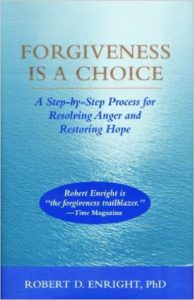


Forgiveness Is a Choice: A Step-by-Step Process for Resolving Anger and Restoring Hope – This is a self-help book for people who have been deeply hurt by another and are caught in a vortex of anger, depression, and resentment.
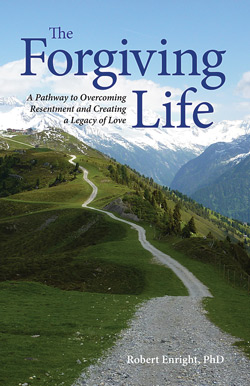
The Forgiving Life: A Pathway to Overcoming Resentment and Creating a Legacy of Love – This book describes a process, followed with success by people around the world, to confront the pain; rise above it to forgive; and in so doing, loosen the grip of the depression, anger, and resentment.
8 Keys to Forgiveness – Dr. Enright’s newest book, just released this month, is a hands-on guide that walks readers through the forgiveness process in just 8 key steps.
Forgiveness Therapy: An Empirical Guide for Resolving Anger and Restoring Hope – Recently published by the American Psychological Association (APA), this manual is for Licensed Psychiatrists and Psychologists as well as other professional counselors.
The 5th Annual Healthy Aging Conference was hosted by Catholic Charities of Madison, WI – a private 501(c)(3) non-profit agency affiliated with Catholic Charities USA, the nation’s largest private network of people helping people.
Read more in the official newspaper of the Diocese of Madison, The Catholic Herald: “Catholic Charities conference focuses on healthy aging.”
Dr. Enright Featured at Healthy Aging Conference
Catholic Charities will host their Fifth Annual Healthy Aging Conference on Wednesday, Sept. 9 at the Sheraton Inn, 706 John Nolen Drive in Madison, WI.
The conference features two keynote speakers and eight workshops devoted to helping seniors, their adult children, and caregivers become familiar with the scope of alternatives that lead to positive and healthy aging.
Dr. Enright pioneered the social scientific study of forgiveness beginning in 1985 and currently works with schools in Belfast, Galilee, and 30 other world communities, helping teachers set-up forgiveness education programs. He is a professor in the Department of Educational Psychology at the UW-Madison and a founding board member of the International Forgiveness Institute, Inc.
Curt Campbell, PT, NCS, ATP will present the noon keynote address, “Mobility and Successful Aging.” Campbell focuses on older adults with neurological issues including Parkinson’s disease, stroke, ALS, multiple sclerosis, vertigo, balance and mobility problems. He has been a Dean Clinic physical therapist for 10 years.
Conference attendees will be able to choose two workshops, one in the morning and one in the afternoon from a selection of eight:
- ”Dimensions of Wellness” by Gayle Laszewski, older adult program director, Goodman Community Center.
- “I Don’t Want to Move, I Want to Stay Independent” by Peggy Carroll, information and assistance specialist, ADRC.
- “Yoga and Fall Prevention” by Paul Mross RYT, LMT, yoga instructor/researcher and founder of Happy, Healthy Aging Preventative Programs: Yoga.
- “I have high blood pressure, not hypertension: Better Health Literacy Means Better Health” by Steve Sparks, director of the Wisconsin Health Literacy.
- ”Boost Your Brain Health: Your brain and how to keep it strong.” Tips to reduce risk of Alzheimer’s and dementia by Joy Schmidt, community education specialist at The Alzheimer’s & Dementia Alliance of Wisconsin.
- ”Diabetes Prevention: Your lifestyle, the easy, but not so easy
choices you make every day” by Paul Manning, chief mission advancement officer at the YMCA of Dane County. - Live Longer: Choose Hospice” by Melanie Ramey JD, MSW / CEO The HOPE of Wisconsin.
- ”Mind Over Matter, Brain Over Bladder” by Dr. Dobie Giles, chief of female pelvic medicine and reconstructive surgery in the UW ob-gyn division of gynecology.
Registration is open online at www.ccmadison.org or by mail. Visit www.ccmadison.org and download an invitation/registration form. For seniors and students, the fee is $35; professionals, $65. The registration deadline is Wednesday, Sept. 2.