
Tagged: “Communities”
Forgiveness Can Expand Your Vision
When we are consistently angry over deep injustices against us, it can narrow our vision. We think about the person and what happened, we dream about the person, we can become preoccupied with the past.

Image by Pexels.com
In contrast, when we forgive, we see both a more complete person in the one who acted badly and an expanded hope for the future. As we forgive one person, we often are motivated to forgive others. As we continue to forgive, there often develops in us a motivation to assist others in their suffering. Our vision expands so that we see beneath the surface of others. We see their pain……and we want to help. As we continue to forgive and to aid others in their suffering, we can begin to expand our view of humanity, of who each person is as someone of inherent worth, special, unique, and irreplaceable.
As we forgive, we expand our vision of: a) the one who hurt us; b) hurting people in general; c) and humanity in general. The expansion tends to be what Lewis Smedes used to call “seeing with new eyes.” These are eyes of expansion, toward greater positivity and hope for humanity. These are eyes of expansion in seeing the self in new ways, with a new meaning and purpose in life for others.
Forgiveness is part of love and beauty and so as we forgive, we become more attuned to both love and beauty and want to contribute more of these into the world. The expanded vision does not lessen what happened, but it makes what happened more bearable as healing takes place and love expands.

What Are the Implications for Forgiveness if We Take the Materialist Perspective that Free Will Does Not Exist?
Nine years ago, I was asked this same question. It is starting to arise again as people consider the materialist philosophy that circumstances and issues other than free will choices determine how people behave. I introduce my answer from 2014 here and add to it. The conclusion remains: Free will is necessary if we are to understand right and wrong and even if we are to understand forgiveness.

(Image by Pexels.com)
We are all connected and so one person’s actions are not necessarily independent from others’ actions. Is this true? Some Eastern philosophies say this. Some Western psychologies say this, too. For example, family systems theory surmises that a misbehaving child likely is being influenced by pressures within the family generated by others’ behavior both inside and outside that family. Psychodynamic theories in psychology say that an adult’s actions can have causes going back to how this person was treated as a child.
Given all of the interrelated ideas above about our being interrelated in our actions, we can then make at least two moves in explaining people’s behavior: 1) no one can truly help certain actions because of others’ influences over us or 2) we all have free will and choose to act rightly or wrongly even if others’ make it hard to be good.
If we take the first turn on our journey of understanding persons, then we weaken such ideas as “right and wrong,” “justice,” and “forgiveness.” After all, how can we say that one person acted wrongly? if we are all so interconnected, then this person is not acting with any kind of genuine volition. In a certain way, his misbehavior can implicate his father, who can implicate his mother, who can implicate……..On it goes until we all share the blame which weakens the case against the original person and his actions under consideration.
If we take the second turn on our journey of understanding persons, then we strengthen such ideas as “right and wrong,” “justice,” and “forgiveness.” After all, the person, even though pressed in on all sides by others, has choices. One need not, for example, hit another person because of frustration. One’s mother has not so abused this person that she was left with one and only one option. Yes, the mother’s misbehavior (whatever it was) may make it difficult for the daughter to control her temper, but control it to a degree she can.
Free will. Independent choices. Break the laws of morality (you will not take the life of an innocent person, for example), and you do wrong. If the wrong is done to me, I can forgive. If the other does not have free will, then an apparent wrong is just that—-apparent. Do I then forgive a person for a wrong? The conclusion is no longer clear. We will have to redefine forgiveness in this case to retain the use of the word “forgiveness.” Forgiveness becomes a kind of acceptance of all along with their actions, no matter how wrong they might appear to be. We still retain such words as “compassion” and “understanding,” but the word forgiveness itself begins to fade.
If the world ever loses the word forgiveness and its true meaning, we are in very big trouble. Inner unrest and conflict within families and communities may know no end. To retain this vital concept, we must retain the truth of free will for each person.
The twelfth of 15 criticisms about forgiveness that I so frequently see is that it is impossible to even understand or define forgiveness because there are so many different definitions of it in the published literature.
This problem is not inherent in forgiveness itself, but instead is a problem with those who write about forgiveness without deeply understanding what it is. As the ancient Greeks, such as Socrates, Plato, and Aristotle, remind us, there is an objective essence (or an unchanging set of characteristics) which typifies each moral virtue. Forgiveness is what it is across historical time and across cultures and, yes, there can be individual and cultural variations in how this essence is expressed. Just because there is a ritual, for example, in Sierra Leone on the West Coast of Africa, in which a community gathers at night around a large bonfire as people forgive one another, does not mean that what forgiveness is there differs in essence from what forgiveness is in a one-on-one forgiveness therapy session in the United States. Those who think about and then write about forgiveness, according to Aristotle, can use their rational faculties to understand, even if imperfectly, what forgiveness is and is not. To forgive is to be good to those who are not good to the forgiver and this goodness includes the motivation to be good to the offending person, the cognitions of goodness toward the person, positive affect, and, when possible, positive behaviors toward that person.
Perseverance as the Missing Piece to Family, School, and Community Forgiveness
Having studied the psychology of forgiveness since 1985 and having helped plant forgiveness education in schools since 2002, I have come to realize that there is another moral virtue that needs to exist alongside forgiving if forgiveness is to mature in minds, hearts, and groups. That virtue is perseverance, or the willed decision and action to keep going despite challenges and to not get distracted by other issues. In the ethical treatise, Virtues and Vices (attributed to Aristotle, but possibly written by one of his followers), the virtue of perseverance or endurance is said to exist alongside the virtue of courage and daring. I would add that perseverance will be a moral virtue as long as it is connected to both wisdom and justice (as well as courage) because it is good only if the goal to which people are dedicating a good part of their lives is fair and reasonable. Persevering in bank robbery, for example, is vice not virtuous.
Perseverance is rarely discussed in modern society as we play with our gadgets and move from one forum to another. This kind of quick movement is part of what the 17th century French philosopher, Blaise Pascal, in his masterful work, Pensées, refers to as diversion. He challenged readers by saying that most people cannot endure even one hour alone in their own room without seeking new diversions. If this was the case over four centuries ago, how much more might diversion be weakening our ability to engage in the moral virtue of perseverance now?

In an earlier blog, I related an interaction with Mr. Brian McParland of St. Vincent de Paul Primary School in Belfast, Northern Ireland in the fall semester of 2002. Upon approving forgiveness education in his school, he told me that I would last only 3 years at this task because that is all the time anyone ever seems to give to new classroom initiatives. In other words, people do not persevere. I have seen the same in local groups that start forgiveness education programs with adults only to have them fade over time. Yet, as Aristotle reminds us, and challenges us, it takes time to grow deeply in the moral virtues. We do not become proficient in any moral virtue by giving it a try for a little while any more than we become physically fit by hitting the gym for a month and then going back to the couch and the potato chips. It takes time and effort to become forgivingly fit. It takes time to grow in the moral virtue of perseverance.
So, it seems to me that the first step in growing intra-personally in forgiveness, in aiding families and schools and local community organizations to grow in forgiveness is to openly and boldly and persistently discuss perseverance and the serious challenge all people face as they say, “Let’s hit the forgiveness gym!” Without perseverance, we lose our forgiving fitness very soon.
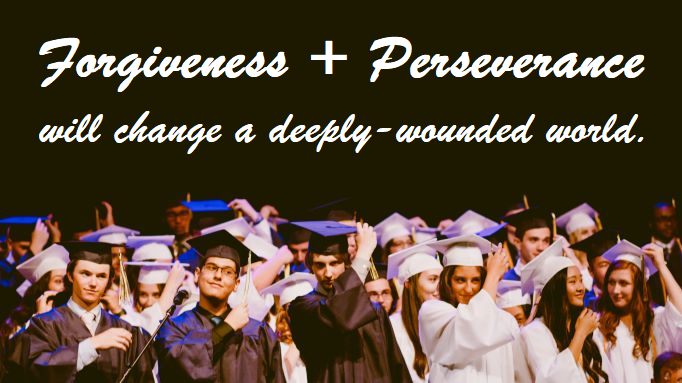
Image by StockSnap.io/Caleb Woods
How much perseverance do we need to change the world? It seems to me that we need to introduce students to forgiveness, without forcing them to forgive, from age 4 to age 18. It seems to me that we need two generations, about 40 years, of forgiveness in communities to change those communities and to change community-to-community conflicts, even brutal conflicts that seem at present to have no end in sight. Forty years? Forty years when there will be new distractions, new shiny diversions? Yes, and it is the teamwork of forgiveness and perseverance, and leaders who will take over for other leaders, that will win in the peace movement. This combination of forgiveness and perseverance never has been tried anywhere in the world at any time in human history. It is time.
With perseverance, we might just be able to bring forgiveness for good to a deeply wounded world. Long live perseverance! Long live forgiveness!
Liberia Seeks Peace Through Forgiveness
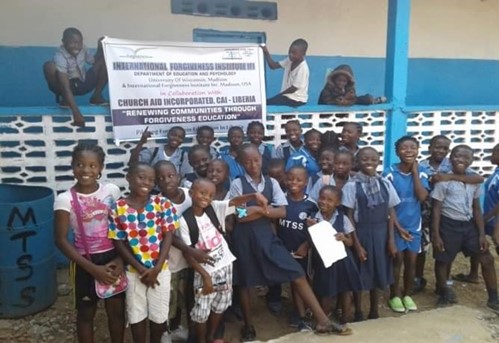
Forgiveness Education class at Mother Tegeste Stewart Apostolic Pentecostal School in Brewerville, Monrovia, Liberia.
Bishop Brown has been working with IFI co-founder Dr. Robert Enright to implement elementary and secondary school Forgiveness Education initiatives (including for all 500 students at the Mother Tegeste Stewart Apostolic Pentecostal School in Brewerville), after-school forgiveness education clubs, and Sunday School forgiveness lessons. Since 2017, Group Forgiveness interventions also have been incorporated into the LFEP thanks to Bishop Brown’s significant role in governmental affairs.
“I suggested that approach, in all humility, because dialogue will not be fruitful if those engaging in the dialogue are still very angry about past grievances,” Dr. Enright explained. “Forgiveness is a scientifically-supported way of eliminating that anger.”

Dr. Robert Enright (via Skype) and Bishop Kortu Brown, LFEP national coordinator, hosted a forgiveness seminar called “Renewing Communities Through Forgiveness Education” on May 13, 2022 in Brewerville, Liberia.
- Can Group Forgiveness In Liberia Lead to Peace?
- A New Strategy for Peace in the World. . . The Enright Forgiveness Inventory
- First Ebola, Now Coronavirus: Liberia Suffers Again