Tagged: “Forgiving”
When we forgive, do we forgive situation or persons?
If forgiveness is a moral virtue in which we are good to persons who are not good to us, then this is a focus exclusively on persons and not on situations. If you think about it, how can you practice moral goodness toward a situation? You cannot be good to a tornado or to a traffic jam. If persons are responsible for the traffic jam and if they are acting unfairly in some way, then you can forgive those persons, but you do not forgive the situation.
You said earlier to me that when we forgive we do not acquiesce to the other’s demands. May I respectfully disagree on this. I disagree because I have been reading recently and seeing on media videos some people discussing what they call “toxic forgiveness.” To those who use this term, there is an element to forgiveness that is out of balance with fairness. Is it not reasonable for all of us to be aware of how forgiveness can get out of balance to such a degree that it becomes “toxic” for the one who forgives?
I think there is a serious misunderstanding of what forgiveness is and what it is not by people who use the words “toxic forgiveness.” They usually refer to people who “forgive” and then just put up with the unfairness of the other person. This is not an issue of forgiveness at all, but instead of a serious misunderstanding of what forgiveness is. When we forgive, we do not give in to the other’s demands. When this happens, the one who supposedly is “forgiving” is instead deciding to turn away from a fair solution and then is calling this “forgiveness.” Forgiveness as a moral virtue of goodness does not give in to unfairness. Otherwise, it would not be a moral virtue at all. Here is an analogy to make my point clearer. Suppose a person wants to become physically fit. This person walks about 200 steps, then sits down and eats a gallon of ice cream. This occurs every day and the person gains 20 pounds. Suppose now that this person says, “I have tried physical fitness and it is toxic. All it does is put weight on me.” Is it really physical fitness that is the problem, or a distortion of what it truly means to start a physical fitness program? Suppose now that many people start saying that physical fitness is “toxic.” Where does the error lie, with physical fitness itself or with a conceptual distortion, and a serious one at that, regarding what it actually means to engage in physical fitness? It is the same with “toxic forgiveness.” People distort the meaning of forgiveness and then proclaim that forgiveness is “toxic.”
FORGIVENESS IS A GIFT
Over the past 20 years, Joe Daguanno has climbed the corporate ladder at the Mid-West Family of Companies to become Chief Profit Strategist – Partner. That means he is a media, branding, and advertising professional who excels at revenue generation. He’s also a pretty good, and consistent, blogger.
What’s up in the Cosmos? is the title of Daguanno’s personal blog that he has been writing for the past dozen years. His recent Dec. 20 blog post was titled “The Gift of Forgiveness.” Here’s a brief excerpt:

Joe Daguanno, Chief Profit Strategist – Partner, Mid-West Family of Companies
Forgiveness is a gift. It’s love. It’s generosity. It’s mercy.
As we give this gift, we heal.
Holding a grudge acts like a tourniquet to the flow of healing. It closes the heart and the wounds remain open.
Real forgiveness takes strength. It takes courage. It takes honesty. It takes time.
But it’s worth it.
So very much.
Daguanno’s depth of perception about forgiveness developed several years ago when he met Dr. Robert Enright, forgiveness research pioneer and founder of the International Forgiveness Institute (IFI). That encounter led Daguanno to spearhead development of a series of public service announcements that were broadcast hundreds of time on Wisconsin Public Radio and by numerous commercial radio stations throughout the Midwest—all at no cost to the IFI.
As his title references, Daguanno is a partner in Mid-West Family of Companies—an alliance of more than 40 radio stations covering 8 separate geographic markets–all assembled by the late Dr. William Walker and his son Thomas Walker. Dr. Walker co-founded the IFI along with Dr. Enright in 1995. Thomas Walker continues to provide the IFI with both financial and hands-on support through the Walker Family Trust.
Read Daguanno’s full Dec. 20 blog: “The Gift of Forgiveness.”
Consider Giving the Gift of Forgiveness This Year
In the season of giving, one of the most beautiful gifts you might consider giving is forgiveness. The ideas that forgiving is a gift to those who have hurt you sometimes gets forgiveness into trouble. In other words, people think it is irrational to consider offering a gift to those who are unfair. The typical reasons for this resistance to forgiveness as gift-giving are these:
- It is dangerous to reach out to those who act unfairly because I am open to further abuse.
- My gift-giving might be a signal to the misbehaving others that their actions are acceptable, which they are not.
- Gift-giving to those who acted unfairly seems counter-intuitive to my own healing. I need to move on and not focus on this other person.
 The ideas above can be countered this way: With regard to (A), you do not necessarily have to reconcile with an unrepentant person who keeps harming you. You can give your gift from a distance, such as a kind word about the person to others or an email so that you can keep your distance if this is prudent to do so. With regard to (B), you can forgive and ask for justice. Forgiving never means that the other just goes ahead as usual with hurtful behaviors. In other words, if you decide to forgive, you can and should ask for fairness from the other person. With regard to (C), forgiveness will seem counter-intuitive as goodness to those who are not good to you only if your focus is entirely on justice or a fair solution to the problem. If you begin to see that mercy (in the form of forgiving) and justice can and should exist side-by-side, then perhaps this idea of forgiveness as a contradiction or as inappropriate or as somehow odd may lessen in you.
Forgiveness can be a gift in these ways:
- As you forgive, you are giving the other person a second chance at a trustworthy relationship with you. Of course, trust takes time to develop, but forgiveness opens the door, even if a little, to trying the trust-route with the other who behaved unjustly.
- Forgiveness can be a merciful way of showing the other what the injustice actually is (or was), making possible positive change in the other. Those who behave badly and are offered this mercy may begin to see the unfairness more clearly and have the inner conviction that change indeed is necessary.
- Forgiveness can be a gift to yourself as you shed abiding anger that could have been yours for many years. You have a second-chance at stronger mental health.
- As you reduce toxic anger, this actually can be an aid in strengthening your relationships with people who were not the ones who acted badly. After all, when people carry around a lot of anger in their hearts, they can displace that anger onto unsuspecting others. Your forgiving one person, then, can be a gift to others who do not have to endure your displaced anger.
So, then, what do you think? Do you see that in the season of giving, one of the most beautiful gifts you might consider giving is forgiveness?

A Fireside Chat with Dr. Robert Enright
Dr. Robert Enright, the 2022 recipient of the prestigious American Psychological Foundation (APF) Gold Medal Award for Impact in Psychology, is featured in a just-released video presentation titled “APF at Home: A Fireside Chat with Dr. Robert Enright.”
The 1 hr. 25 min. fireside chat is part of a series developed by the APF that focuses on pioneering American psychologists “whose work has had a game-changing impact on the field of psychology.” Dr. Enright, founder of the International Forgiveness Institute (IFI), has been called “the forgiveness trailblazer” by Time magazine. His 37-years of forgiveness research has resulted in noteworthy innovations in forgiveness education and forgiveness therapy.
“Fireside Chats,” became a popular communications tool when President Franklin Roosevelt began a series of radio broadcasts that aired from 1933 through 1944. They were planned as conversations rather than stiff public speeches and were widely listened to because all the national radio networks carried them. In them, the President appeared to talk with his listeners rather than lecturing at them. And, yes, he actually sat next to the White House fireplace during the broadcasts.
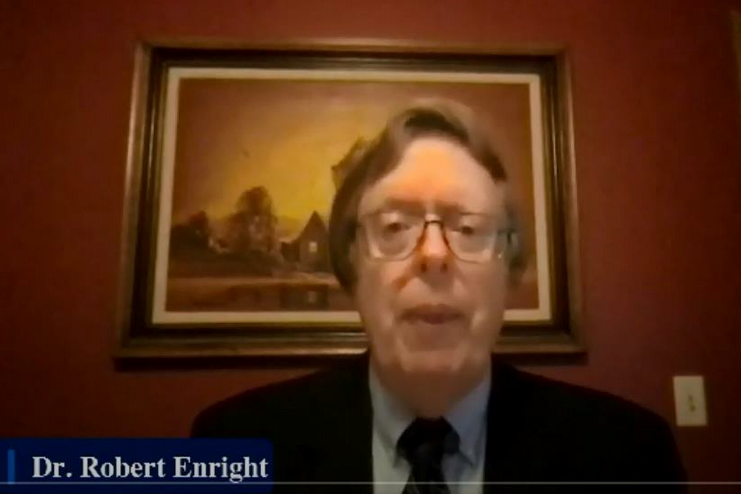 The fireside chats now being produced by the APF are intended to replicate that informal ambience. The latest interview, for example, features APF Trustee Dr. Katherine Nordal chatting with Dr. Enright. She asks him questions like how he selected forgiveness as the topic of his life’s work, how his Process Model of Forgiveness can be used in therapy interventions, and how forgiveness can become the crucial missing piece of the world’s peace puzzle. Dr. Enright answers questions submitted by viewers of the live presentation during the final 20 minutes of the session.
Dr. Nordal is well-equipped to conduct the APF fireside chat with Dr. Enright. She is a licensed psychologist whose distinguished career included owning and managing a full-time group private practice in Mississippi for 28 years. She spent another 10 years as Executive Director for Professional Practice for the American Psychological Association (APA) before retiring in 2018.
APF is the private grant-making arm of the APA and provides more than a million dollars annually in awards to fund research by psychologists and psychology students.
More Information:
A Fireside Chat with Dr. Robert Enright – Watch the entire presentation on YouTube.
APF at Home Fireside Chats – Watch all the videos in the series.