IFI News
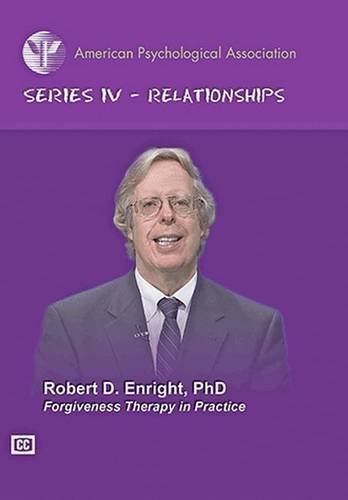
Just Released: New Training Video by Dr. Enright – “Forgiveness Therapy in Practice”
 Forgiveness is the process of uncovering and letting go of anger at someone who has caused pain. This process can be the path to healing in many situations, as anger is frequently at the core of a client’s issues and may be the center of a number of disorders.
The forgiveness therapy model is flexible enough to be integrated into any therapeutic approach. Fostering forgiveness in therapy involves uncovering the depth of the client’s anger, obtaining commitment to forgive, and working on being able to forgive. The final phase of this therapy is the discovery of meaning in what has been suffered, finding a new purpose in life, and exploring one’s own faults and the need to be forgiven by others.
In this 100-minute video program, Dr. Enright demonstrates his approach to forgiveness therapy with a female client who feels hurt by her mother.
This video, produced by the APA, is not available for sale on this website.
Order exclusively from:
Forgiveness Education Expands in Lebanon
Saida, Southern Lebanon – About 40 miles south of Lebanon’s capital of Beirut, the International Forgiveness Institute – Lebanon is making major inroads into the sectarian violence that has disrupted and crippled the country for years. Calling its program “Forgiveness Education for Violence Prevention and Peace Building,” the Lebanon effort is headed up by Ramy Darwich Taleb who grew up in the northern part of the country. Here is Ramy’s most recent progress report on the IFI program:
Our goal is to make forgiveness principles known throughout Lebanon with programs at schools, refugee camps, youth centers and churches because we believe that Forgiveness Education for Violence Prevention and Peace building brings about behavioral change that will help prevent conflict and the practice of violence.
Due to the cultural impact the younger generation is minted with the idea of taking revenge to defend one’s honor. Many have never heard of Forgiveness as an option of dealing with conflict in a peaceful way.

Ramy Darwich Taleb (in white sweater) works with students.
We are very glad to have been given the opportunity to implement the forgiveness program in a public school near Saida, the South of Lebanon. The school has a variety of Lebanese, Syrian, Palestinian and Gipsy students which depicts the miniature version of the situation in the whole country very well. Obviously these students have barely ever heard about forgiveness, which makes us even more excited and thankful to be able to impact these youth.
For the beginning we chose a group of 230 students from grade 1 to 9 that will partake in the 7 sessions Forgiveness program for 7 weeks. We divided the group into two groups, which means our Facilitators will work with the first 115 kids from February to March and the second group from April to May. The principle of the school seems to be very open to the program, so we might be able to establish a full year curriculum for the next school year.
Another Organisation called “Open Gates” in Saida that works with Bedouin women, invited us to provide a weekly program, starting in February for a group of 10 young women at the age of 17-28 that combines bible studies with the forgiveness program. These women live in a Muslim community but are interested in learning more about Jesus. They partake in a Jewellery project that provides work and a spiritual home for them.
IFI-Lebanon teamed up with other relief organizations last Sunday (Feb. 14) to conduct the first bridge-building event for Lebanese, Palestinian and Syrian youth in Lebanon. Through a day-long series of fun team activities, the event helped overcome hostility and break down barriers of sectarian division in Lebanon.
Read more about Bridge-Building activities in Lebanon.
In addition, our team strives to stay in contact with the youth groups from the Palestinian camp Shatila, the Lebanese/ Syrian Youth group from Barja and the Syrian students from grade 4 and 5 from the Syrian Refugee School in Choueifet, that already participated in the Forgiveness Program. We scheduled a meeting with every youth group individually once a month and plan a monthly event with all of the groups together to work on reconciliation between these opposing people groups. For this month we will have an activity by the sea with surfing opportunities and games.
During our work in the Shatila camp we have recognized a need of relief work within the camp. We got in contact with 3 families that are in need of medical or financial support that we want to address. Therefor we plan on visiting these families every other week, to bring the message of forgiveness and as well provide for their urgent needs.

Ramy with his family.
Furthermore, we got in contact with Youth for Christ Lebanon (YFC Inc.) who want to dedicate this year 2016 to reconciliation. The IFI Lebanon Team will provide a one-day staff Training for YFC staff to introduce the Forgiveness Program and discuss further cooperation.
A group of Ex-Fighters of the civil war that aim to promote peace and reconciliation through their testimonies on schools and other institutions have invited Ramy to introduce the Forgiveness Educational Program to this group to discuss further cooperation as well.
Another opportunity has opened up with a community center called “Tahadde” that is placed in one of the poorest living areas for Lebanese. We are invited to do the program with their youth- and women groups and plan on doing so in April.
Ramy Darwich Taleb
Forgiveness Education Around the World
Editor’s Note – As Dr. Enright winds down his world forgiveness travels this month, he provided this update from Galilee, Israel. Here is the encouraging news from each of the countries he is visiting.
Belfast, Northern Ireland
We had many meetings in Belfast including a two-day workshop on forgiveness education for teachers from 10 different integrated schools. The integrated schools have both Irish Catholic and British Protestant students going to the same schools. Up until about 10 years ago, this was very rare.
Last June, a 2-hour “Forgiveness Education Pilot Session” was held at Hazelwood Integrated Public School by NICIE- the Northern Ireland Council for Integrated Education. Since then, one of the teachers there has been working to recruit other schools into the program and we’ve worked very closely with NICIE to expand the Forgiveness Program to other integrated schools.
Athens and Thessaloniki, Greece
Peli Galiti, a native of Athens who now lives in Madison, is taking the lead in bringing forgiveness education to about 1,000 students in Greece this year.
She arranged for me to speak at two public meetings and two meetings with teachers. These were very productive, especially the public talk in Athens where 350 people showed up—a capacity crowd. In Thessaloniki, more than 150 people attended our presentation. The enthusiasm was evident among both crowds. It seems to me that Greece is fertile ground on which forgiveness education can grow.
Peli is arranging for our anti-bullying forgiveness guide to be translated and published in June by an Athenian publisher who will do the same with our Curriculum Guides.
Visit the IFI-Greece pages on Facebook.
Jerusalem and Galilee, Israel
Doors are also opening for forgiveness education in Israel. I had a meeting yesterday with educators not only from Jerusalem but also as far away as Jericho (a six-hour walk–15 miles, 24 km—with an elevation increase of about 3,400 ft, 1060 km).
A peace leader here is encouraging me to initiate a major conference in June of 2017 with a focus on forgiveness within the Hebrew/Jewish, Christian, and Muslim traditions (day one) followed by a second day of talks on Forgiveness Education, with invitations going to people in Greece, Belfast, Liberia, Israel, Saudi Arabia, and anywhere else we would like to plant forgiveness education.
Hmmmm…..a major conference on forgiveness and forgiveness education in Jerusalem? With a publication of the papers presented there?…….Ok……… Would any of you like to help work on the development of this major conference in Jerusalem? I have a donor in mind in Milwaukee. We shall see.
Today we’re off to the Mar Elias Educational Institutions (MEEI) in Ibillin, Galilee, where we began a Forgiveness Program in their high school last year. This school year, eight high school teachers at MEEI are teaching forgiveness, involving about 600 students in the lessons.
I’ll meet with the head of Education in Galilee before trekking back to Jerusalem for more meetings with peace leaders there, who all of a sudden are seeing the great need for forgiveness education.
For example, a school system that encompasses Jerusalem, Jericho, and the West Bank today committed to forgiveness education for all students from pre-kindergarten through 12th grade – 20 schools and 10,000 students. I will try my best. They want me back in mid-August to do teacher training. They could become a model for this area of the Middle East……..we shall see.
One peace leader in Galilee said to me yesterday, “There is no way out of the conflicts here unless forgiveness is in the center.” Ask me if I agree with this. Oh, and this same peace leader wants to start forgiveness education in the prisons of Israel, which he mentioned to me before I mentioned to him our latest initiatives at the Columbia, WI maximum security prison. He was surprised and happy to hear of our ideas.
The Philippines
Finally, I will head to the Philippines, a tropical Southeast Asian country composed of more than 7,100 islands that are home to more than 98 million people.
The acceptance of forgiveness education in Manila and neighboring Quezon City has been exceptional since last year when we started working with Metro Manila Christian Church and Hope Worldwide, an international organization that provides protection, education and health services to poor Filipino children.
Visit the IFI-Philippines pages on Facebook.
Forgiveness Education Underway in Lebanon
IFI News, Beirut, Lebanon – A long and painful history of civil wars, ethnic struggles, and invasions by other countries has plagued the country of Lebanon for decades. Now, the International Forgiveness Institute (IFI) is on the front lines to help ameliorate the ongoing conflict by establishing IFI-Lebanon, an international branch office led by Lebanese native Ramy Taleb.
The current conflict in Lebanon began in 2011 when fighting from the Civil War in neighboring Syria spilled over into Lebanon. The Syrian conflict has been described as having stoked a “resurgence of sectarian violence in Lebanon” between Sunni Muslims, Shia Muslims, the Alawite minority, and other groups including the Islamic State of Iraq and the Levant (ISIL, also referred to as ISIS).
Since 2011, more than 800 Lebanese have been killed and nearly 3,000 injured. Adding to the unease, more than 800,000 registered Syrian refugees were living in Lebanon in 2013, according to the United Nations. Even though Lebanon closed its borders in 2014, the number of registered as well as undocumented Syrian refugees now living in Lebanon is estimated at 1.5 million.
Ramy has already established Forgiveness Education Programs at: 1) Kings Kids Educational Centre in Choufet/ Mount Lebanon for 120 Syrian refugee students; 2) a refugee camp in Shatila/Beirut with two youth groups made up of 29 Syrian-Palestinian refugees; and, 3) at Barja/Mount Lebanon camp with 15 Syrian refugees.
Additionally, Ramy and IFI-Lebanon teamed up with the international organization Youth With a Mission (YWAM) to conduct the first “Faith and Conflict Conference.” The conference involved groups from around the world spending 10 days traveling throughout Lebanon to hear people’s stories about life in the midst of conflict, to see the consequences of war and hatred with their own eyes, and what forgiveness has to do with all that.

Ramy Taleb with students.
“Forgiveness Education for Violence Prevention and Peace Building promotes the development of knowledge, skills, attitudes and values needed to bring about behavioral change that will help prevent conflict and violence through the practice of forgiveness,” according to Ramy.
“Our goal is to make forgiveness principles known throughout Lebanon with programs at schools, refugee camps, youth centers and churches,” Ramy added. “Nearly everyone we’ve reached thus far, but especially the kids, are very eager to learn, open to sharing and touched by the forgiveness program.”
Medical, Psychology and Religious Professionals Learn About “The Healing Art of Forgiveness”
Orthodox Christian professionals in and allied to medicine, psychology and religion learned about “The Healing Art of Forgiveness” at an international conference held in Boston, MA, last weekend (Nov. 5-7).

Peli Galiti, Program Manager, International Forgiveness Institute
Peli Galiti, Ph.D., delivered the forgiveness workshop as part of the Annual Conference of OCAMPR–The Orthodox Christian Association of Medicine, Psychology, and Religion. She shared the stage at the Conference with distinguished speakers including: the Director of the Pediatric Psychiatric Care Program at the Montreal (Canada) Children’s Hospital; a psychotherapy and pastoral care specialist from Kitherona, Greece; and, a psychiatrist who is a priest in the Church of Greece and a Visiting Scholar at Harvard Divinity School.
Peli’s workshop included an Orthodox perspective of forgiveness, a synopsis of Dr. Robert Enright’s scientific research studies, and an overview of the Greek Forgiveness Education Program she established in Athens, Greece, two years ago with Dr. Enright’s guidance and which she now operates as Program Manager for the International Forgiveness Institute.
Peli was born in Athens where she earned her Ph.D. in Educational Psychology from the University of Athens before doing post-graduate work in family therapy at hospitals and medical centers in both the US and Greece. She now lives in Madison, WI, with her husband (a pediatric cardiac anesthesiologist at American Family Children’s Hospital) and their four children.
OCAMPR is an organization that “fosters interdisciplinary dialogue and promotes Christian fellowship among healing professionals in medicine, psychology and religion.” Its professional members have practices in medicine, nursing, mental health, psychology, ethics, theology, parish ministry, parish nursing, prison and community ministry, social services, and military, institutional and community chaplaincy.
Peli provided a similar presentation at the biennial Metropolis of Chicago Clergy-Laity-Philoptochos Assembly, Archon Retreat and Philoptochos Retreat held in Madison from Nov. 14th through Nov. 18th. The Greek Orthodox Metropolis of Chicago consists of thirty-four parishes in Illinois, with another twenty-four parishes in Wisconsin, Minnesota, Iowa, northern Indiana, and eastern and central Missouri.