IFI News
South Korean Leader Begs Forgiveness for his Role in Spreading Coronavirus Disease
BBC News, South Korea – The leader of a religious sect in South Korea has publicly apologized and begged forgiveness for the role he and his followers played in spreading the coronavirus (COVID-19) to thousands of others there.
“I would like to offer my sincere apology to the people on behalf of the members,” said Lee Man-hee, head of the Shincheonji Church of Jesus, a new religious movement (NRM) group. “We did our best but weren’t able to contain it fully.”
Wearing a white mask and fogged glasses, the 88-year-old Lee suddenly stood up in the middle of reading his remarks at a hastily-arranged news conference outside the Shincheonji Church in Gapyeong on March 3rd. He twice silently knelt beside the desk he was seated at and bowed his head to the ground over clasped hands, a significant gesture of contrition in Korean custom.
Lee is the charismatic, self-proclaimed messiah (“the second coming of Jesus”) of the church he founded in 1984. He has been widely criticized for failing to do enough to stop the virus after one of its members tested positive and infected many others.
A 61-year-old female church member developed a fever on February 10 but refused to be tested until a week later. By that time, she had participated in at least two services (along with more than 1,000 other followers) at a Shincheonji Church in the city of Daegu. She also traveled to crowded spots in the capital of Seoul (metro population of 25.6 million) before she contacted a hospital to get tested.
The next day, Feb. 18, health authorities announced she was the country’s 31st confirmed coronavirus case. After that, the number of confirmed cases in South Korea skyrocketed with the majority in the region of Daegu. As of March 22, the country had recorded 8,961 confirmed coronavirus cases (75% of them in Daegu) and 111 deaths, according to the Centers for Disease Control and Prevention in Seoul.
“I don’t know how this happened, but we will make utmost of efforts, and we are aware that we were wrong,” Lee said at the news conference. “We thank the government for making efforts when what we had tried to stop the coronavirus spread wasn’t enough.”
Lee’s news conference came after Seoul’s mayor filed a criminal complaint asking for an investigation into Lee and other church leaders on charges including murder for their failure to cooperate with health officials. Lee had previously called coronavirus the “devil’s deed” designed to stop his church’s growth (he claims about 200,000 followers in South Korea) but, following government orders, he has closed all of the church’s 74 sanctuaries around the country.
South Korean President Moon Jae-in has declared the city of Daegu and parts of the surrounding province as “special disaster zones” because of the unusually high number of confirmed cases in that area. Growing anger over the sect’s handling of the outbreak has sparked a petition calling for the church to be disbanded. Nearly 1.2 million people have already signed it.
Meanwhile, the Centers for Disease Control and Prevention (Washington, DC) recommends that travelers avoid all nonessential travel to South Korea. For an update on the worldwide pandemic, please scroll down to see the article Tracking the Global Coronavirus Outbreak.
Learn More:
- Watch: A 3 min. 24 sec. Wall Street Journal video news report of Lee’s apology.
- Read: In a pandemic, religion can be a balm and a risk
- Read: The Leader of the Religious Sect that Spread Coronavirus In South Korea Says Sorry
- Read: How One Patient Turned Korea’s Virus Outbreak Into an Epidemic
- Keep Up-To-Date: Centers for Disease Control and Prevention
Tracking the Global Coronavirus Outbreak
The coronavirus pandemic has sickened more than 577,400 people, according to official counts. As of Friday evening, at least 26,678 people have died, and the virus has been detected in at least 171 countries, as graphically illustrated on these maps by
There is evidence on six continents of sustained transmission of the virus. The Centers for Disease Control and Prevention has advised against all non-essential travel throughout most of Europe, and to South Korea, China and Iran. The agency has also warned that older and at-risk Americans should avoid travel to any country.
The outbreak is believed to have begun in a seafood and poultry market in Wuhan, a city of 11 million people in central China. The virus seems to spread very easily, especially in confined spaces, making containment efforts difficult. It is difficult to know how many people who contract the virus die, but some early estimates put the fatality rate at roughly 1 percent.
The number of known coronavirus cases in the United States continues to grow quickly and has now surpassed that of any other country in the world including mainland China where the virus supposedly originated. As of Thursday morning, there have been at least 100,973 cases of coronavirus confirmed by lab tests and 1,572 deaths in the U.S., according to a New York Times database. That same database details confirmed cases and deaths for all 171 countries.
While the outbreak is a serious public health concern, most people who contract the coronavirus do not become seriously ill, and only a small percentage require intensive care. Older people and those with existing health conditions, like heart or lung disease, are at higher risk.
Coronavirus disease 2019 (COVID-19) is an infectious disease caused by severe acute respiratory syndrome coronavirus 2 (SARS-CoV-2). The disease was first identified in 2019 in Wuhan, the capital of Hubei province in central China, and has since spread globally, resulting in the 2019–20 coronavirus pandemic.
Common symptoms include fever, cough, and shortness of breath. Muscle pain, sputum production, diarrhea, and sore throat are less common. While the majority of cases result in mild symptoms, some progress to severe pneumonia and multi-organ failure. As of 20 March 2020, the rate of deaths per number of diagnosed cases is 4.1 percent; however, it ranges from 0.2 percent to 15 percent, according to age group and other health problems.
The virus is typically spread from one person to another via respiratory droplets produced during coughing. It may also be spread from touching contaminated surfaces and then touching one’s face. Time from exposure to onset of symptoms is generally between two and fourteen days, with an average of five days.
Learn More:
- How to Protect Yourself and Prepare for the Coronavirus
- How the Coronavirus Can and Cannot Spread
- Visit the John Hopkins University and Medicine Coronavirus Resource Center
- Visit the Harvard University Medical School Coronavirus Resource Center
Forgiveness Therapy Proposed as Antidote for Traumatic Childhood Experiences
Forgiveness Therapy and forgiveness interventions developed by Dr. Robert Enright are being embraced in a just-released study as promising tools for effectively dealing with what the study calls a “major public health crisis.”
Researchers at the Laureate Institute for Brain Research (Tulsa, OK) have teamed up with those at Stanford University (Stanford, CA) to study the life-long adverse impacts of Early Life Adversity (ELA). The study is titled “Is There an Ace Up Our Sleeve? A Review of Interventions and Strategies for Addressing Behavioral and Neurobiological Effects of Adverse Childhood Experiences in Youth.” It was published just five days ago, March 13, 2020, in the empirical journal Adversity and Resilience Science.
ELA is the term for the negative experiences children may face or witness while growing up (sometimes also called Adverse Childhood Experiences—ACEs). These traumatic experiences include:
- emotional, physical, or sexual abuse;
- emotional or physical neglect;
- living in a household in which domestic violence occurs;
- growing up in household dealing with substance abuse or mental health problems;
- instability due to parental separation, divorce or incarceration;
- witnessing violence in the home; or,
- having a family member attempt suicide.
Any of those traumatic experiences can lead to what child development specialists call “toxic stress” if encountered by children without adequate adult support. Toxic stress can disrupt early brain development and compromise functioning of the nervous and immune systems. The more adverse experiences in childhood, the greater the likelihood of developmental delays and other problems that can cause life-long complications.
In fact, psychologists say, adults with more adverse experiences in early childhood are also more likely to have health problems including alcoholism, depression, heart disease, diabetes and other chronic diseases as well as impaired cognitive and social development. The report suggests that many adult diseases are, in fact, developmental disorders that begin early in life.
The new ELA publication describes and evaluates existing evidence-based interventions and their outcomes including Forgiveness Therapy. Three of Dr. Enright’s peer-reviewed empirical studies were examined and cited for achieving commendable outcomes compared to those of a control group:
- Female incest survivors (Freedman & Enright, 1996). Results: “significantly greater decrease in levels of depression and anxiety.”
- Women diagnosed with fibromyalgia who had experienced at least two ACEs in their childhood (Lee & Enright, 2014). Results: “increases in forgiveness toward their abuser, lower levels of state anger, and improvements in physical health related to their fibromyalgia symptoms.”
- Female Pakistani adolescents with histories of abuse (Rahman, Iftikhar, Kim & Enright, 2018). Results: Similar findings to the fibromyalgia study “suggesting that Forgiveness Therapy may uphold in a cross-cultural context.”
Those three intervention experiments by Dr. Enright and his research partners are the only Forgiveness Therapy examples cited in the 24-page ELA study that “have shown forgiveness therapy to be effective” in both physically and emotionally healthy ways. The ELA study also postulates that those interventions are effective because in Dr. Enright’s approach “the hypothesized mechanism behind forgiveness therapy involves cognitive restructuring of the abuser and events.”
Based on the evidence gather through this new ELA study, Forgiveness Therapy is one of the promising interventions for children who are experiencing toxic stress without appropriate support from parents or other concerned caregivers. That, they conclude, can help return a child’s stress response system back to normal while reducing negative mental and physical health outcomes later in life.
“Therefore, we conclude that they (Forgiveness Therapy interventions) are well-suited for and hold promise to exert immediate preventive and sustained changes in outcomes for maltreated youth.” – ELA study conclusion, March 13, 2020.
Why is this subject important? Why does it matter?
According to the World Health Organization, as many as 39% of children worldwide are estimated to experience one or more forms of early life adversity, placing a high economic burden on health-care systems—and society in general—through medical costs and lost productivity.
The mission of the Laureate Institute for Brain Research (LIBR) is to “develop novel therapeutics, cures and preventions to improve the well-being of persons who suffer from or are at risk for neuropsychiatric illness.” Dr. Namik Kirlic, the LIBR Principal Investigator for the ELA study, is a clinical psychologist who has devoted his professional life to studying ELA interventions and how to optimize their positive outcomes. Other team members for the ELA study include Zsofia Cohen (Dr. Kirlic’s Research Assistant) and Dr. Manpreet Singh, a psychiatrist and medical doctor at Stanford Health Care.
MORE INFORMATION:
- Read the full, 24-page ELA study on Adverse Childhood Experiences.
- Learn more about Adverse Childhood Experiences on the Psychology Today website.
- Find out how toxic stress can have damaging effects on learning, behavior, and health across the lifespan at the Harvard University Center on the Developing Child.
- Read about Early Childhood Development on the U.S. Department of Health & Human Services Office of Early Childhood Development website.
Forgiveness: “Groundbreaking Scientific Discovery”
A cutting-edge organization in California that sponsors groundbreaking scientific discoveries has launched a new service called Greater Good in Action and added forgiveness to its list of practices that can help you improve your social or emotional well-being or the well-being of others including your children.
 The Greater Good Science Center (GGSC) at the University of California, Berkeley, not only studies the psychology, sociology, and neuroscience of well-being but also “teaches skills that foster a happier life and a more compassionate society–the science of a meaningful life.”
The Greater Good in Action initiative adds forgiveness to its list of established practices that include compassion, generosity, gratitude, honesty and others. It is a new addition to a service the organization began in July of 2017, called Raising Caring, Courageous Kids that is designed to help parents raise kids of high character who treat others with compassion and respect.
In its inaugural forgiveness practice called Introducing Kids to Forgiveness, Greater Good in Action cites the pioneering forgiveness work of psychologist Robert Enright, Ph.D., and psychiatrist Richard Fitzgibbons, M.D. (co-authors of Forgiveness Therapy, a manual providing instructions for clinicians who want to incorporate forgiveness interventions into their therapy with clients.
Referencing Dr. Enright’s years of hands-on experience teaching children about forgiveness (he has developed 17 Forgiveness Curriculum Guides for kids in pre-school through 12th grade that are being used in more than 30 countries around the world), Greater Good in Action links readers to a separate dissertation on Dr. Enright’s insights into how to help children and adolescents learn and practice forgiveness.
That work concludes that “a wide range of studies have found that forgiveness programs can help kids of different ages feel better, strengthen their relationships, and improve their academic performance.”
Because conflict is inevitable, teaching children about forgiveness early on
may indeed be a path toward building communities
of people who prize and cultivate peace.
Maryam Abdullah, Ph.D., Parenting Program Director at Greater Good
and a developmental psychologist with expertise in parent-child relationships.
The practices provided by Greater Good in Action are for anyone who wants to improve his or her social and emotional well-being, or the well-being of others, but doesn’t necessarily have the time or money to invest in a formal program. Through its free online magazine Greater Good, the GGSC provides articles, videos, exercises, quizzes, podcasts, workshops and more for parents and families to help them foster positive attributes like forgiveness in themselves and their children.
How Forgiving Are You?
When someone does you wrong, are you more likely to turn the other cheek or slash their tires? Take the Greater Good Forgiveness Quiz to find out.
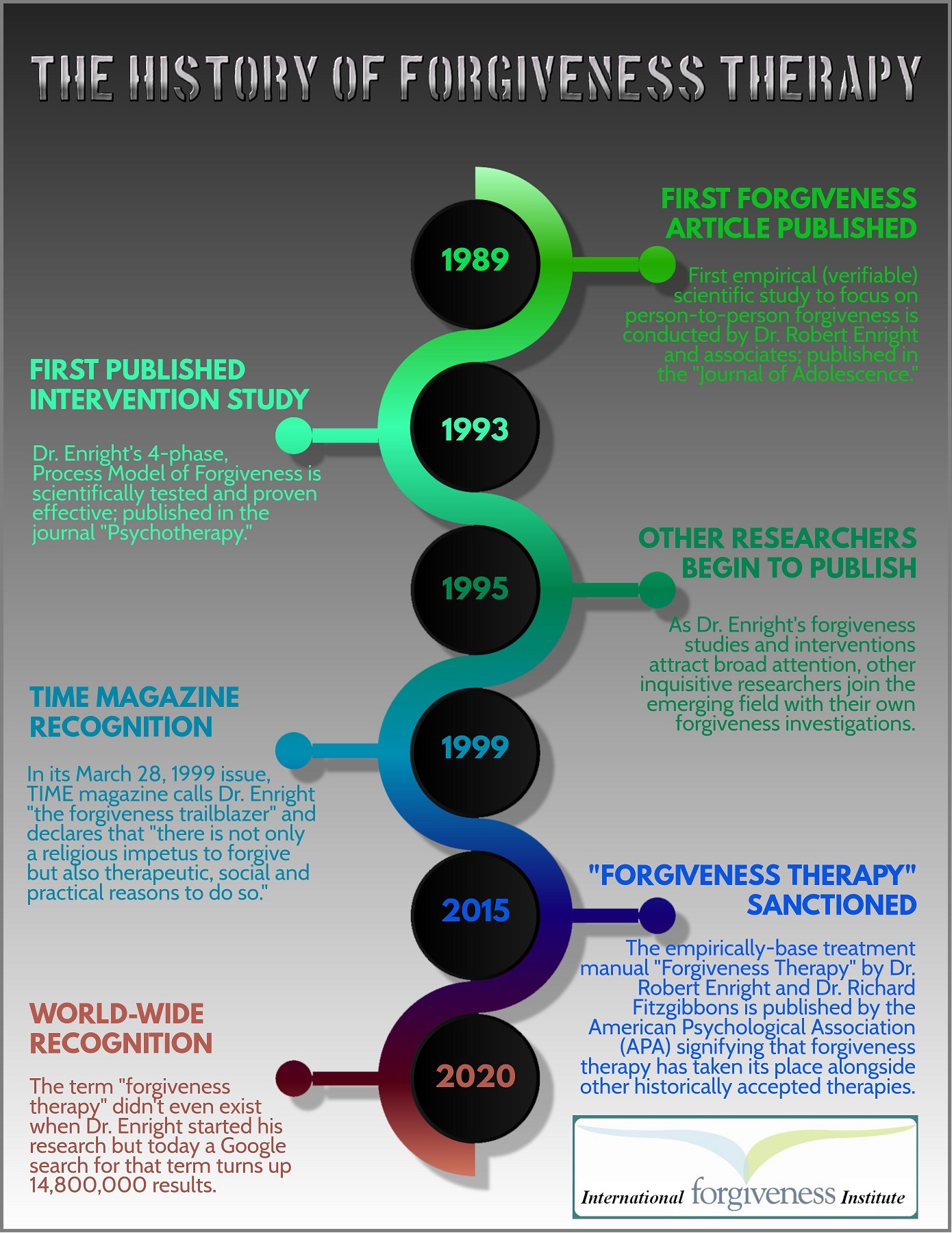
The History of Forgiveness Therapy
The prominence of forgiveness and forgiveness therapy in the field of psychology over the past few decades has been well-documented in the scientific literature. Also well documented has been the pioneering and groundbreaking forgiveness work of Dr. Robert Enright within that movement. Here are pertinent milestones: