
Tagged: “forgiveness is a choice”
Matthew Perry, Shame, and Self-Forgiveness
For many people, Matthew Perry was most well known as the fun-loving, affable, charming Chandler Bing from the iconic 90s sitcom ‘Friends’. As with all people who live their lives in front of an audience, there is always a more complex story and this was no different for Matthew Perry, who tragically passed away recently. Thankfully, he sought to address his personal and relational struggles with honesty and courage and was not afraid to share that journey with others.

Image from Pexels.com
In the aftermath of his premature death, the New York Times posted a guest essay by Heather Havrilesky in which she reflected on some excerpts from Perry’s autobiography that addressed his experience of shame, self-forgiveness, and how his journey of self-forgiveness can be a pathway to becoming more forgiving and compassionate with others.
Havrilesky reflects in the article that Matthew Perry seems to feel a constant sense of shame that he just cannot shake:
In fact, the one person Mr. Perry can’t seem to forgive, at least for a majority of his book, is himself. He casts himself as the person who deserves blame for everything that happens.
She goes on to propose that many of us struggle with a similar dynamic of shame and self-loathing and that we would do well to walk the path of self-forgiveness so that we may find peace and be able to extend that peace to others around us. As she states elsewhere in her essay:
[W]hen you find forgiveness inside your own heart, suddenly, it’s everywhere else as well.
Be sure to read and share the essay as an invitation to experience the healing that self-forgiveness offers!
On Contemplating the Forgiveness Process to “Do No Harm”
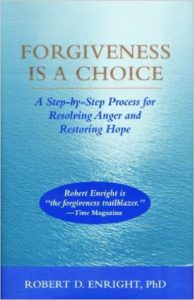
 There is a part of the forgiving process that we have described in two distinct publications, The Forgiving Life and Forgiveness Is a Choice, where we ask the forgiver to “Do no harm” to the one who has been unfair. In actuality, the concept of “Do no harm” serves as a bridge to the much more challenging task of loving someone who has wronged you. Even though it’s an earlier and purportedly simpler step in the process, “Do no harm” is anything but simple.
 Three things are meant by “do no harm”: 1) Don’t try to deliberately hurt the person who offended you (such as being impolite); 2) Don’t do covert harm (such as sneering, ignoring at a gathering, or remaining impartial toward this one who shares personhood with you); and 3) Don’t hurt other people because of your inner discontent from the one who was unfair to you. Stated differently, it is surprisingly simple to channel your resentment toward Person X onto Persons Y and Z. Perhaps it is a sign that you are projecting anger from a past encounter onto your present interactions if people have to inquire, “What is wrong with my friend today?”
It’s wise to assess your level of resentment at these moments and consider who you should forgive today. Consider asking yourself: As I offer forgiveness, am I “doing no harm”? Because of what I am going through, am I exercising caution so as not to hurt innocent people?
I’m offering you a challenge today: Don’t hurt anyone today. Do the same tomorrow. Do it the day after that.

What Moral Virtue Underlies Forgiving?
Some say the underlying moral virtue of forgiveness is respect as we see the worth in others. I make the claim in the book, The Forgiving Life, that the deepest moral virtue underlying forgiveness is love, particularly agape. Here is an excerpt on agape from The Forgiving Life (2012):
Image by Pexels.com
Love, properly understood, reaches higher and goes farther in explaining who we are compared with rationality, free will, and even good will. According to Aristotle, there are four different kinds of love: the natural love that exists, for example, between a mother and her child (storge in Greek), the love that develops strongly among friends (philia), the love that is forged between romantic partners (eros), and a fourth love (agape) based on service to others (developed more fully in medieval times by Thomas Aquinas). The first three kinds of love (storge, philia, and eros) depend for their proper expression on agape or service love (loving even when you do not feel like it, loving when you are tired, loving when the other seems unlovable). C.S. Lewis, who wrote The Chronicles of Narnia, makes this point of the philosophical centrality of agape. Agape, according to Lewis, is the highest form of love precisely because it nobly and courageously perseveres when the other kinds of love say, “Ouch! I’m outta here! Run!” With agape love, a person chooses to love, even when it hurts. In other words, it comes from a free will (we choose it) and from both a good will (we choose it to help others even if we are uncomfortable) and a strong will (we do not run away from and carry on despite the difficulty), and it makes sense (coming from a position of rationality).[1] Agape love has an inherent goodness within it that is missing from rationality and free will.
Further, without a sense of love which is deliberately in service to others, all of the other loves can be distorted and not be inherently good in themselves. Take eros as an example. Is it the best kind of romantic relationship when the partner degenerates into a “What’s in it for me?” pattern? Agape balances the tendency in eros to seek one’s own pleasure primarily and says, instead, “How may I serve you?” Agape is a kind of love that has dignity, quiet, and strength as it seeks to build up and even restore others. Agape helps us to see others as possessing inherent worth, a quality that is not earned. The paradox of agape in the context of forgiveness is that as a person reaches out to others who have been unjust, he experiences considerable emotional healing.
I used the word “balance” in the paragraph above. Balance was an important idea for Aristotle, who called it temperance. Each expression of love, whether it is storge, agape or another variety, itself needs balance unless it becomes distorted by overdoing or under-doing it. For example, if people distort agape by begrudgingly overdoing it, they could perform supposed acts of love with deep resentment, deplete their own reserves, or burn out, without being able to love well at all. If people under-do agape, their efforts may be half-hearted, even indifferent as they preform this lazy distortion of agape. The point is to strive for a good, solid expression of service love without overdoing or under-doing it. Wisdom helps us to know how much is enough.
Love then, in the form of agape, may be the most fundamental and the most important aspect of our being for this one reason: It is inherently good in that, by its definition, we seek meaningful and healthy relationships with others, and therefore it is good for others and for us. All other virtues, by themselves, do not necessarily fulfill any lasting connection between and among people. Justice, by itself, can be a rather cold virtue as, say, a magistrate almost indifferently sentences a person as a rightful punishment for a crime. Courage, by itself, can be a grim duty as, say, a soldier goes to battle because he is ordered to do so. If the need for meaningful connections is part of our religious, ethical, psychological, and biological essence, then agape love is central to that essence. If the fulfillment of meaningful connections is part of our end-point as human beings, then the mature understanding and expression of agape love is a major part of that end point or what philosophers call our summum bonum or greatest good to which we strive.
[1] Lewis, C.S. (1960). The four loves. New York: Harcourt, Brace, & World. I can almost hear Kant say something like this: Love is an end-point of morality (what we are striving for) whereas a good will is what we need fundamentally at the beginning to make any moral response possible. I would argue, instead, that love is both a fundamental issue (existing at first in us as a capacity and as an actuality developing slowly in small ways) and as an end-point. It is our essence (our fundamental building block of morality, along with rationality, and a free, good, and strong will) and its perfection is our goal (as we grow stronger in it with practice and reflection).
Forgiveness Can Expand Your Vision
When we are consistently angry over deep injustices against us, it can narrow our vision. We think about the person and what happened, we dream about the person, we can become preoccupied with the past.

Image by Pexels.com
In contrast, when we forgive, we see both a more complete person in the one who acted badly and an expanded hope for the future. As we forgive one person, we often are motivated to forgive others. As we continue to forgive, there often develops in us a motivation to assist others in their suffering. Our vision expands so that we see beneath the surface of others. We see their pain……and we want to help. As we continue to forgive and to aid others in their suffering, we can begin to expand our view of humanity, of who each person is as someone of inherent worth, special, unique, and irreplaceable.
As we forgive, we expand our vision of: a) the one who hurt us; b) hurting people in general; c) and humanity in general. The expansion tends to be what Lewis Smedes used to call “seeing with new eyes.” These are eyes of expansion, toward greater positivity and hope for humanity. These are eyes of expansion in seeing the self in new ways, with a new meaning and purpose in life for others.
Forgiveness is part of love and beauty and so as we forgive, we become more attuned to both love and beauty and want to contribute more of these into the world. The expanded vision does not lessen what happened, but it makes what happened more bearable as healing takes place and love expands.
What Are the Implications for Forgiveness if We Take the Materialist Perspective that Free Will Does Not Exist?
Nine years ago, I was asked this same question. It is starting to arise again as people consider the materialist philosophy that circumstances and issues other than free will choices determine how people behave. I introduce my answer from 2014 here and add to it. The conclusion remains: Free will is necessary if we are to understand right and wrong and even if we are to understand forgiveness.

(Image by Pexels.com)
We are all connected and so one person’s actions are not necessarily independent from others’ actions. Is this true? Some Eastern philosophies say this. Some Western psychologies say this, too. For example, family systems theory surmises that a misbehaving child likely is being influenced by pressures within the family generated by others’ behavior both inside and outside that family. Psychodynamic theories in psychology say that an adult’s actions can have causes going back to how this person was treated as a child.
Given all of the interrelated ideas above about our being interrelated in our actions, we can then make at least two moves in explaining people’s behavior: 1) no one can truly help certain actions because of others’ influences over us or 2) we all have free will and choose to act rightly or wrongly even if others’ make it hard to be good.
If we take the first turn on our journey of understanding persons, then we weaken such ideas as “right and wrong,” “justice,” and “forgiveness.” After all, how can we say that one person acted wrongly? if we are all so interconnected, then this person is not acting with any kind of genuine volition. In a certain way, his misbehavior can implicate his father, who can implicate his mother, who can implicate……..On it goes until we all share the blame which weakens the case against the original person and his actions under consideration.
If we take the second turn on our journey of understanding persons, then we strengthen such ideas as “right and wrong,” “justice,” and “forgiveness.” After all, the person, even though pressed in on all sides by others, has choices. One need not, for example, hit another person because of frustration. One’s mother has not so abused this person that she was left with one and only one option. Yes, the mother’s misbehavior (whatever it was) may make it difficult for the daughter to control her temper, but control it to a degree she can.
Free will. Independent choices. Break the laws of morality (you will not take the life of an innocent person, for example), and you do wrong. If the wrong is done to me, I can forgive. If the other does not have free will, then an apparent wrong is just that—-apparent. Do I then forgive a person for a wrong? The conclusion is no longer clear. We will have to redefine forgiveness in this case to retain the use of the word “forgiveness.” Forgiveness becomes a kind of acceptance of all along with their actions, no matter how wrong they might appear to be. We still retain such words as “compassion” and “understanding,” but the word forgiveness itself begins to fade.
If the world ever loses the word forgiveness and its true meaning, we are in very big trouble. Inner unrest and conflict within families and communities may know no end. To retain this vital concept, we must retain the truth of free will for each person.